Reflection AI
Reflection AI unveils Beam, a 501B open-weight model it will release under Apache 2.0
The sparse mixture-of-experts model activates 23B parameters per token, reads up to 1M tokens and, by Reflection's own numbers, competes with GLM 5.2 on coding and agent work. The weights, technical report and quantized versions are due later in October; for now there is only an early access program.
Share this news
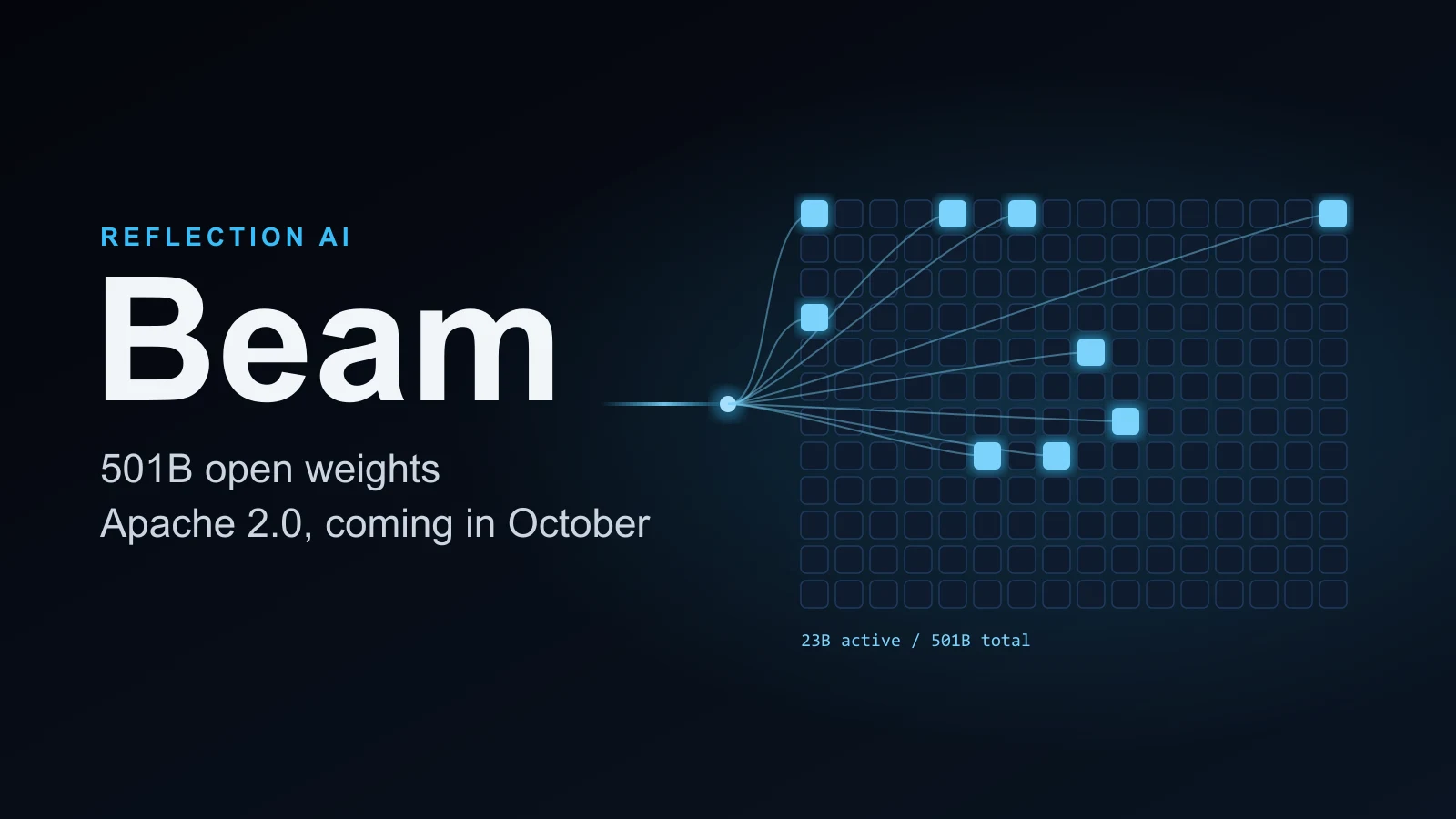
Reflection AI announced Beam on Monday, a text-only model with 501 billion total parameters, 23 billion of them active for each token, trained for coding, reasoning and agent work. It was pretrained on 23.8 trillion tokens on 6,144 NVIDIA GB300 GPUs in under four weeks, then spent another four weeks in reinforcement learning on about 10,500 GB300s, generating more than 100 million rollouts graded in 1.3 billion sandboxes. "Beam advances the Western open-weight frontier," the company wrote.
Reflection says the weights will ship under the Apache 2.0 license later this month, together with a technical report, a model card, FP8 and NVFP4 quantized versions and tools to fine-tune it. Until then Beam is available only through an early access program. The startup, founded by former Google DeepMind researchers Misha Laskin and Ioannis Antonoglou, raised money at a $25 billion valuation a few months ago, according to SiliconANGLE.
Where it sits
Reflection's own table puts Beam at 77.2% on SWE-Bench Pro v2-Hard, 80.1% on Terminal Bench v2.1, 44.4% on DeepSWE v1.1, 97.8% on AIME 2026 and 90.5% on GPQA Diamond. The company calls it competitive with GLM 5.2, a model with about 250 billion more parameters, at three to four times less inference compute for similar reasoning scores, and close to Qwen 3.8-Max on coding and agent tasks. It also says Kimi K3 stays ahead on raw capability. Those three are the open models from Zhipu, Alibaba and Moonshot that have led open weights this year, and Beam is pitched at companies that want a model of that class from an American lab. On DeepSWE, the hardest of the coding tests, the closed frontier is still far off: Google reported 77.9% for Gemini 4 Argon last week.
The design aims at serving cost. With 23 billion active parameters, each token costs about as much compute as a mid-size dense model, but all 501 billion still have to sit in memory: roughly 500 GB of weights in FP8 and about 280 GB in NVFP4, which means a multi-GPU server, not a workstation.
What isn't out yet
Every number above comes from Reflection's own evaluation harness, and nobody outside the company can check them until the weights and serving code are public. The 1M-token context was reached during midtraining, while reinforcement learning ran at 256K, and a window the architecture supports says little about accuracy across all of it. The firm part of the announcement is the license: Apache 2.0 allows commercial use, modification and fine-tuning without the usage restrictions that come with custom model licenses. Whether the rest holds up will be clear once the weights ship later this month.
Sources and further reading
Share this news
Related Items
- NewsMistral unveils Large 4, a 1-trillion-parameter model it will release with open weights this monthThe mixture-of-experts model activates 49B parameters per token, reads text and images and, by Mistral's numbers, leads the open models from China on agentic coding. The API is in preview at $1.36 and $4.18 per million tokens, cyber defenders get a less restricted version first, and the weights are due October 27.
- NewsMeta releases Muse Spark Open, an 816B open-weight model built to run on two Mac StudiosThe mixture-of-experts model activates 42B of its 816B parameters per token, reads text, images, video and audio, and has a 1M-token context. Meta calls it the most capable US open-weight model, and its own table backs that up while still putting it behind GLM 5.3 and Kimi K3 on most agent and coding benchmarks.
- NewsZ.ai's GLM-Legal nearly matches Gemini 4 Argon on legal agent work, at a seventieth of the costThe legal model, built on GLM-5.3-Flash with reinforcement learning across tens of thousands of legal environments, passes 19.2% of the tasks in Harvey's Legal Agent Benchmark, seventh on Vals AI's leaderboard at 15 cents a task. It is a gated beta for law firms, with no published price and no open weights for now.
Comments
Questions, corrections, or your own take are all welcome. Sign in with GitHub to join in.