Meta
Meta releases Muse Spark Open, an 816B open-weight model built to run on two Mac Studios
The mixture-of-experts model activates 42B of its 816B parameters per token, reads text, images, video and audio, and has a 1M-token context. Meta calls it the most capable US open-weight model, and its own table backs that up while still putting it behind GLM 5.3 and Kimi K3 on most agent and coding benchmarks.
Share this news
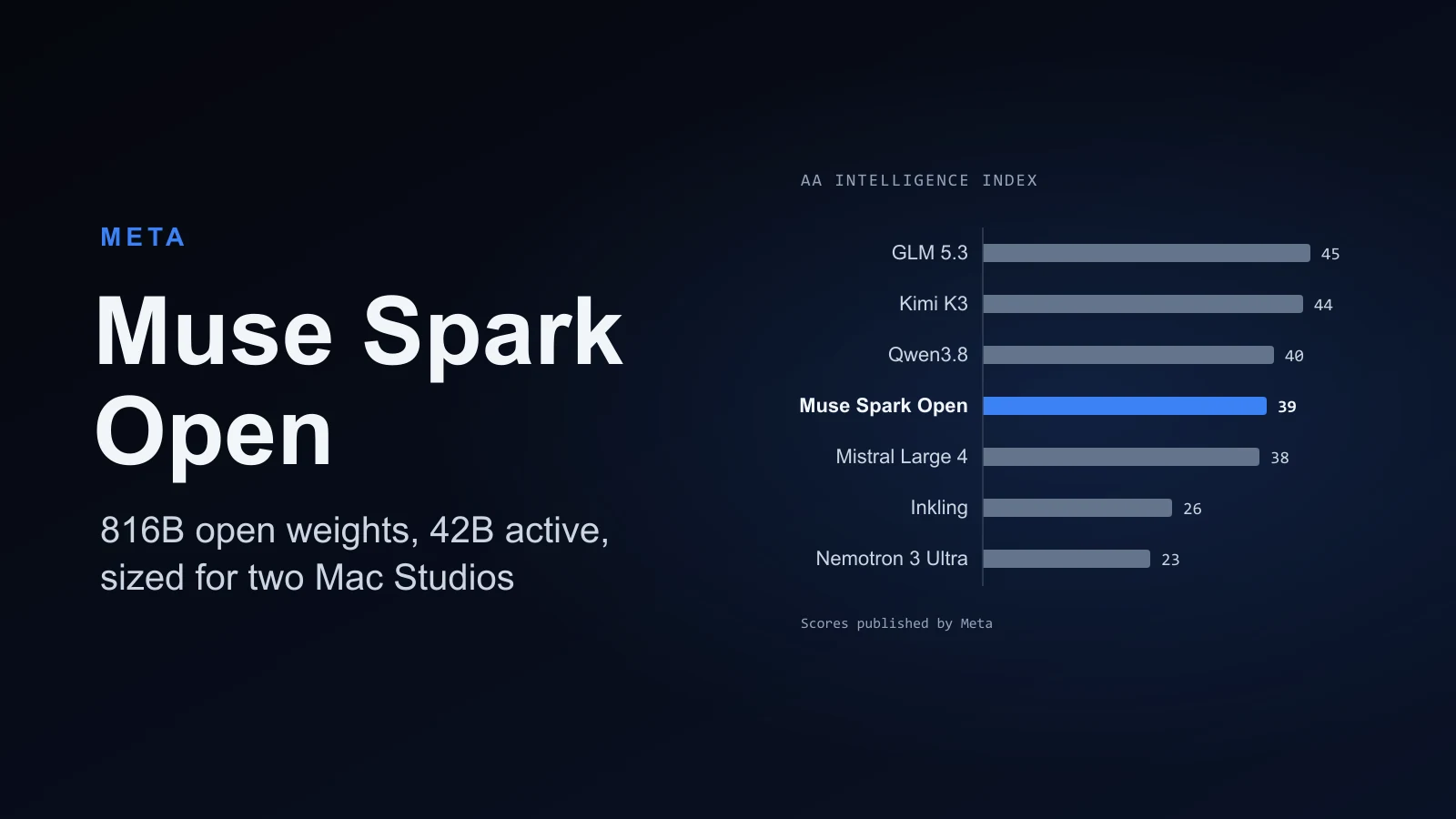
Meta released the weights of Muse Spark Open on Thursday, an open version of the model behind its Muse Spark family. It is a mixture-of-experts transformer with 816 billion parameters, of which 42 billion are active per token (8 of 256 experts per layer), a 1-million-token context window and native input of text, images, video and audio. The BF16 and NVFP4 checkpoints are on Hugging Face behind an access form, and hosted APIs are live on Baseten, Fireworks AI, Groq, Modal, Nebius, OpenRouter and Together AI.
Meta built the launch around Apple hardware. Two Mac Studios with the M5 Ultra and 512 GB of unified memory each, linked over Thunderbolt 5 and splitting the model with MLX, hold the whole thing, which Meta describes as two machines that "behave like one supercomputer with a terabyte of unified memory." The 512 GB configuration only ships later this month; Engadget notes that four 256 GB Mac Studios also work and cost about $38,000. On servers, the model card asks for about 2 TB of memory in BF16 and at least 700 GB of VRAM in NVFP4.
Where it lands on Meta's own table
Meta calls it "the most capable US open-weight model to date," and the other US entries in its table back that up. Muse Spark Open scores 39 on the Artificial Analysis Intelligence Index, against 23 for Nvidia's Nemotron 3 Ultra, and beats Reflection AI's Beam on 6 of the 8 benchmarks both report. It also edges Mistral Large 4, at 38 on the index. It leads every model in the table on MCP-Atlas (89.2), JobBench (61.8), Humanity's Last Exam without tools (26.1) and AA Omniscience (25).
The same table shows where the open-weight frontier still is. Z.ai's GLM 5.3 scores 45 on the Intelligence Index and Kimi K3 scores 44. On coding and terminal work, Muse Spark Open gets 60 on DeepSWE 1.1 against 67 for GLM 5.3 and 68 for Kimi K3, and 76.4 on Terminal-Bench 2.1, below both of them and below Beam at 80.1. Every number is Meta's, run at its highest reasoning effort, so independent results will matter more than usual.
The safety columns are the starkest. Under adaptive StrongREJECT attacks the model complied 0.5% of the time, against 62.9% to 86.4% for the other open models tested, but it also refused more harmless requests on FORTRESS (17.4%, against 2.7% for Kimi K3). Meta says the open weights got extra safety post-training and recommends wrapping them in system-level guardrails, since none ship with the checkpoint.
The license
The Muse Model License has no monthly-user cap. Its limit is on revenue: a company selling access to the model or its derivatives as a service must sign a separate agreement with Meta once that business passes $20 million in gross revenue over 12 months, while internal use and shipping it inside your own product don't trigger it. Products must show "Built with Muse Spark Open," Meta claims no rights to the outputs, and downloading the weights requires a form with your legal name, date of birth and organization.
Sources and further reading
- Original publication
- Meta AI Research: Muse Spark Open
- Hugging Face: Muse-Spark-Open-816B-A42B model card
- TechCrunch: Meta launches an open-weight AI model that runs on Macs
- 9to5Mac: Meta launches new Muse Spark Open model, optimized to run on Mac Studio
- Engadget: Meta built a huge open-weight AI model for Macs, but you'll need 1TB of RAM to run it
Share this news
Related Items
- NewsReflection AI unveils Beam, a 501B open-weight model it will release under Apache 2.0The sparse mixture-of-experts model activates 23B parameters per token, reads up to 1M tokens and, by Reflection's own numbers, competes with GLM 5.2 on coding and agent work. The weights, technical report and quantized versions are due later in October; for now there is only an early access program.
- NewsMistral unveils Large 4, a 1-trillion-parameter model it will release with open weights this monthThe mixture-of-experts model activates 49B parameters per token, reads text and images and, by Mistral's numbers, leads the open models from China on agentic coding. The API is in preview at $1.36 and $4.18 per million tokens, cyber defenders get a less restricted version first, and the weights are due October 27.
- NewsBlack Forest Labs releases FLUX 3 Image, with 4K output and edits placed by coordinatesThe image model of the FLUX 3 family generates and edits through one endpoint, combines up to ten reference images and lets developers place or change elements with bounding boxes. It costs $0.048 per 1K image, half that until October 8, and open weights are promised within weeks.
Comments
Questions, corrections, or your own take are all welcome. Sign in with GitHub to join in.