Google announces Gemini 4 Argon, its new frontier model, and gives it to cyber defenders first
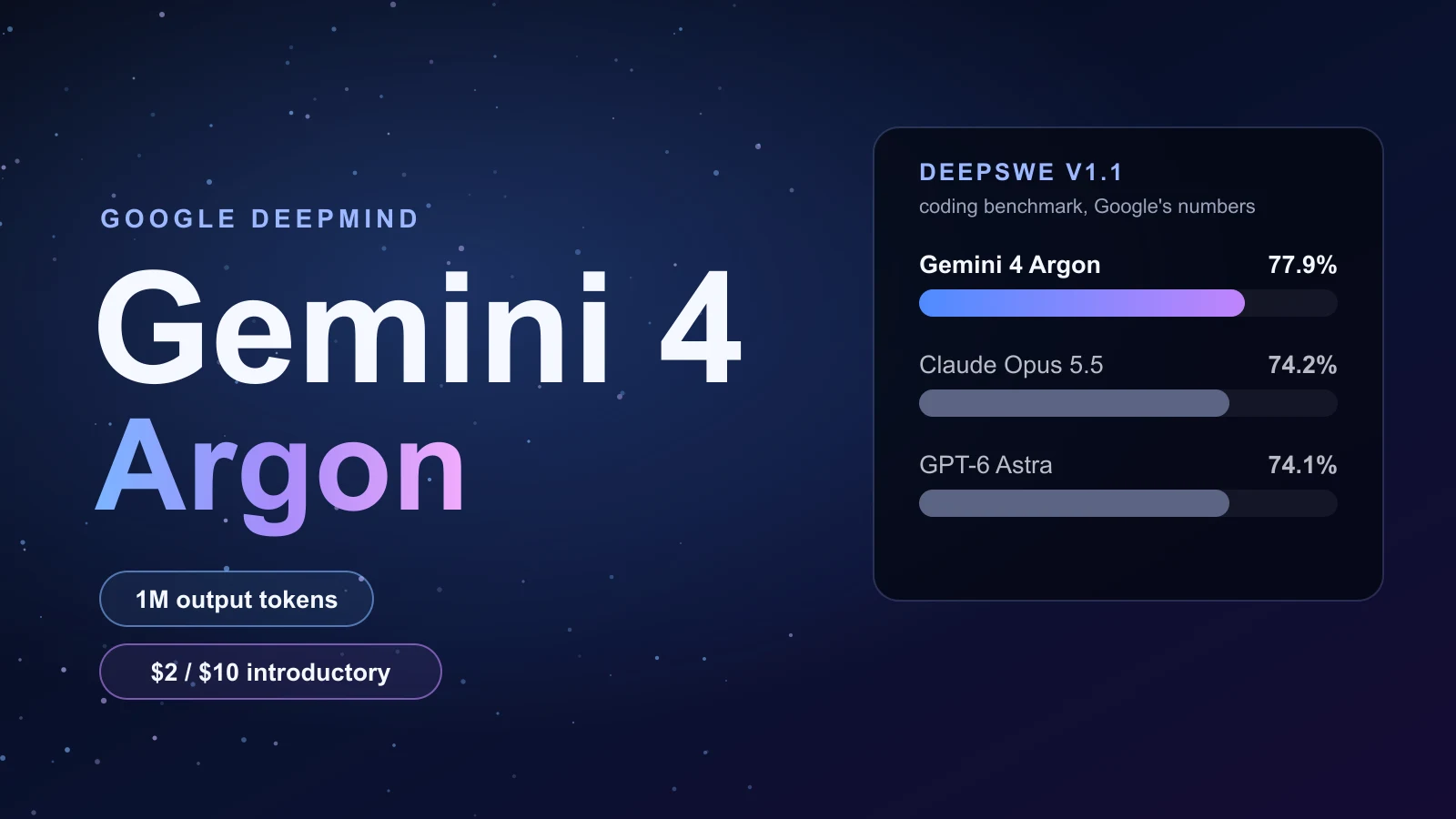
Argon scores 77.9% on DeepSWE, against 74.2% for Claude Opus 5.5 and 74.1% for GPT-6 Astra, and can write up to 1 million tokens in one answer. It launches at $2 and $10 per million tokens, rising later to $4 and $20, once it reaches paid API customers and Google AI Ultra.
Share this news
Google announced Gemini 4 Argon on Wednesday, the first model of its next generation, built for software engineering, enterprise knowledge work and cyber defense. Koray Kavukcuoglu, Google DeepMind's chief AI architect, wrote that Argon "is fundamentally changing the way we work and build at Google," where it already runs thousands of internal workflows. The first outside users are the trusted cyber defenders in Google's Fairwind Program. Google AI Ultra subscribers and paid API customers get it "soon", with no date yet.
On DeepSWE v1.1, a coding benchmark, Argon scores 77.9%, against 74.2% for Claude Opus 5.5 and 74.1% for GPT-6 Astra. Its output limit goes from 64,000 tokens to 1 million, so a single answer can carry hundreds of thousands of tokens of reasoning and code. The introductory price is $2 per million input tokens and $10 per million output tokens, with cached input 95% cheaper; after the introductory period it becomes $4 and $20.
The numbers Google published
Besides DeepSWE, Google claims first place on AutomationBench, Zapier's test of end-to-end business workflows, with 51.3%; state of the art on LVBench, for long video, with 91.7%; and a tie for first on CWE-bench v1, which measures how well a model fixes security vulnerabilities, at 68%. It also says Argon leads the Vals Index across finance, coding, legal and tax work, and Harvey's benchmark for legal agents.
All of these come from Google's announcement, and nobody outside the Fairwind Program can check them yet. For reference, OpenAI published 75.2% on DeepSWE v1.1 for GPT-6.1 Sol on Tuesday, at the same $2 and $10 that Argon charges during its introductory period. Argon's standard price, $4 and $20, is what Claude Opus 5.5 costs today.
An answer that can reach 1 million tokens
The output limit is the change developers will notice first. GPT-6.1 Sol stops at 128,000 output tokens; Argon can keep going to 1 million, and Google presents that headroom as the point: "When the model has the headroom to think deeply and generate hundreds of thousands of tokens in a single trajectory, it adds a new level of depth in reasoning to solve tough problems in one go."
It also changes the bill. A request that uses the whole limit costs $10 in output at the introductory price and $20 at the standard one, and it takes as long as generating a million tokens takes. When Argon reaches the API, set a maximum output per request and a spending alert before you point an agent at it.
Defenders first
Argon was built partly for cyber defense, and Google is giving it first to vetted defenders, the same order Anthropic followed with Claude Mythos Preview. The week's news explains the caution: on Tuesday Anthropic's red team reported that an open-weight model, GLM-5.3, already builds exploits almost as well as Mythos Preview. Google hasn't given a date for the wider rollout, so for everyone else the numbers above are a promise to test when access opens.
Sources and further reading
Share this news
Related Items
- NewsMistral unveils Large 4, a 1-trillion-parameter model it will release with open weights this monthThe mixture-of-experts model activates 49B parameters per token, reads text and images and, by Mistral's numbers, leads the open models from China on agentic coding. The API is in preview at $1.36 and $4.18 per million tokens, cyber defenders get a less restricted version first, and the weights are due October 27.
- NewsZ.ai's GLM-Legal nearly matches Gemini 4 Argon on legal agent work, at a seventieth of the costThe legal model, built on GLM-5.3-Flash with reinforcement learning across tens of thousands of legal environments, passes 19.2% of the tasks in Harvey's Legal Agent Benchmark, seventh on Vals AI's leaderboard at 15 cents a task. It is a gated beta for law firms, with no published price and no open weights for now.
- NewsOpenAI and Synopsys build GPT-Synopsys, a model that runs chip design tools on its ownEngineers give it a design goal and the model runs Synopsys' EDA tools, reads the results, makes changes and iterates until the design checks out. OpenAI licenses the tools and the two share revenue, but there is no launch date, price or benchmark yet.
Comments
Questions, corrections, or your own take are all welcome. Sign in with GitHub to join in.