Black Forest Labs
Black Forest Labs releases FLUX 3 Image, with 4K output and edits placed by coordinates
The image model of the FLUX 3 family generates and edits through one endpoint, combines up to ten reference images and lets developers place or change elements with bounding boxes. It costs $0.048 per 1K image, half that until October 8, and open weights are promised within weeks.
Share this news
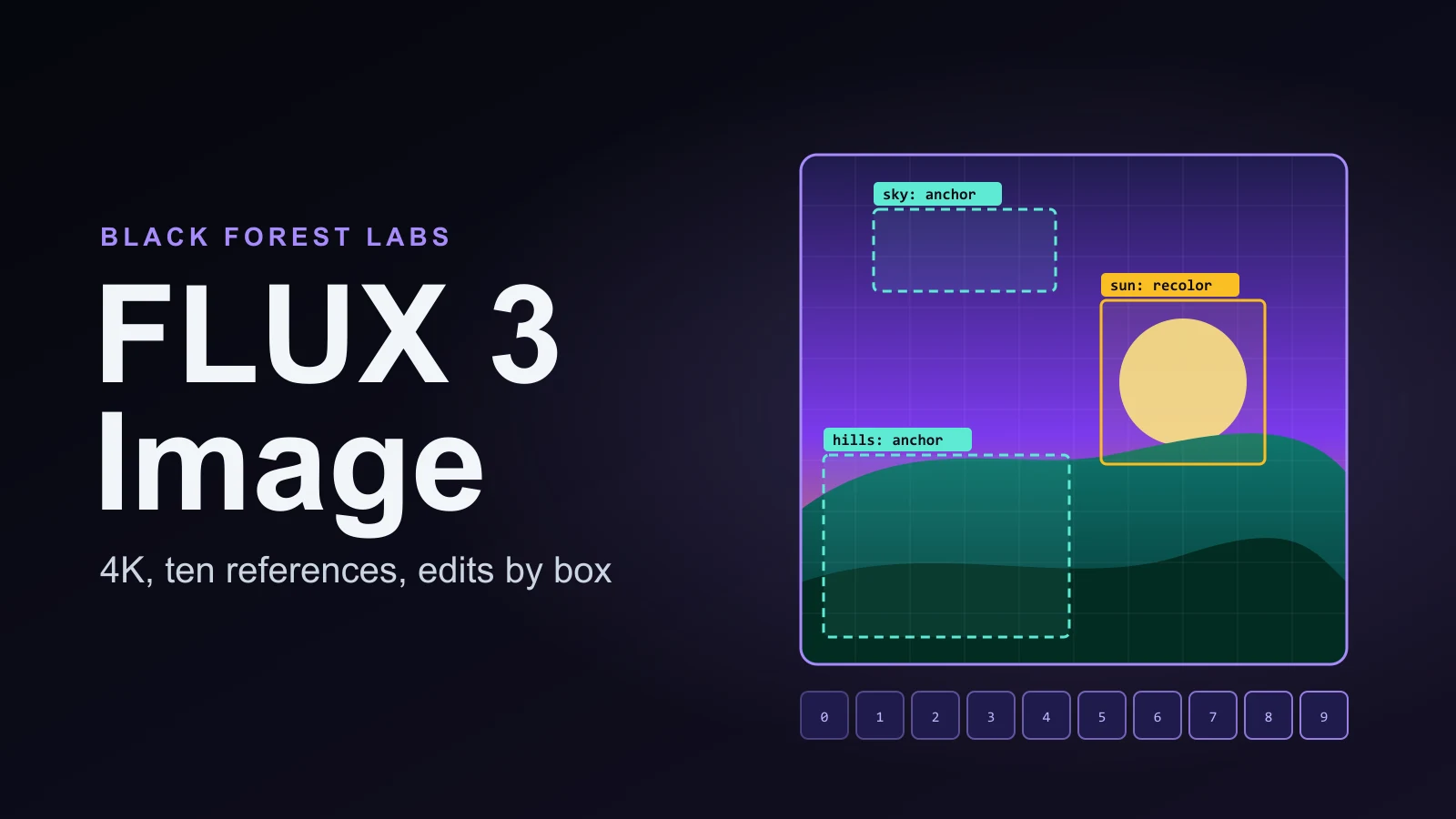
Black Forest Labs released FLUX 3 Image on Thursday, the image side of the FLUX 3 family it announced in July alongside video, audio and robotics models. A single API endpoint handles text-to-image and editing, takes up to ten reference images in one request and renders natively at fixed tiers from 768 pixels up to 4K, about 16.8 megapixels, without a separate upscaling pass. The company says the highest tier can take several minutes per image.
The default 1K image costs $0.048, rising to $0.10 at 2K and $0.607 at 4K, and every tier is half price through October 8. The model is available in the BFL playground and API, a commercial license covers running the weights on your own hardware, and an open-weight version is promised "within weeks", without a date.
Editing with coordinates
The feature that sets FLUX 3 Image apart from most image APIs is its layout system. A request can describe each element of a scene with a name, a caption and a bounding box on a normalized 0 to 1000 grid, written as [y0, x0, y1, x1], so the same coordinates work at any aspect ratio. To edit, you mark the boxes to change (remove, add, replace, recolor or move an element) and "anchor" boxes for what must stay, and the model regenerates only those regions. The references are cited in the prompt by position, so "the jacket from the third image on the person in box 2" is a valid instruction. There is no negative prompt field; the documentation tells users to describe what they want instead.
That makes it a tool for production work more than for one-off prompts: product photos where only the color changes, ad layouts with copy in fixed places, a character kept consistent across a campaign. BFL's own examples show the pixels outside the edited boxes matching the input, with between 68% and 94% of each image left identical in the cases it documents.
What it doesn't show yet
The release comes without numbers to judge it by. BFL published no benchmark for FLUX 3 Image, no measured layout accuracy, no latency figures and no preservation rate beyond its examples, so the claims about precise placement and untouched pixels can only be checked by trying it. The open weights also matter more than usual here: FLUX became a default for local image generation because earlier versions shipped open models, and the FLUX 3 Dev weights promised in July have not been released yet. The competition is close behind: Ideogram's version 4.5 is also built around editing, and Ideogram is also promising open weights.
Sources and further reading
Share this news
Related Items
- NewsMeta releases Muse Spark Open, an 816B open-weight model built to run on two Mac StudiosThe mixture-of-experts model activates 42B of its 816B parameters per token, reads text, images, video and audio, and has a 1M-token context. Meta calls it the most capable US open-weight model, and its own table backs that up while still putting it behind GLM 5.3 and Kimi K3 on most agent and coding benchmarks.
- NewsAnthropic releases Claude Sonnet 5.5: Opus-level agentic coding at a Sonnet priceThe second model in the 5.5 family runs over 30% faster than Sonnet 5, costs up to 30% less per task, keeps the $2 and $10 per million token prices, and beats Opus 5.5 on Terminal-Bench.
- NewsMistral unveils Large 4, a 1-trillion-parameter model it will release with open weights this monthThe mixture-of-experts model activates 49B parameters per token, reads text and images and, by Mistral's numbers, leads the open models from China on agentic coding. The API is in preview at $1.36 and $4.18 per million tokens, cyber defenders get a less restricted version first, and the weights are due October 27.
Comments
Questions, corrections, or your own take are all welcome. Sign in with GitHub to join in.