Anthropic
Anthropic releases Claude Sonnet 5.5: Opus-level agentic coding at a Sonnet price
The second model in the 5.5 family runs over 30% faster than Sonnet 5, costs up to 30% less per task, keeps the $2 and $10 per million token prices, and beats Opus 5.5 on Terminal-Bench.
Share this news
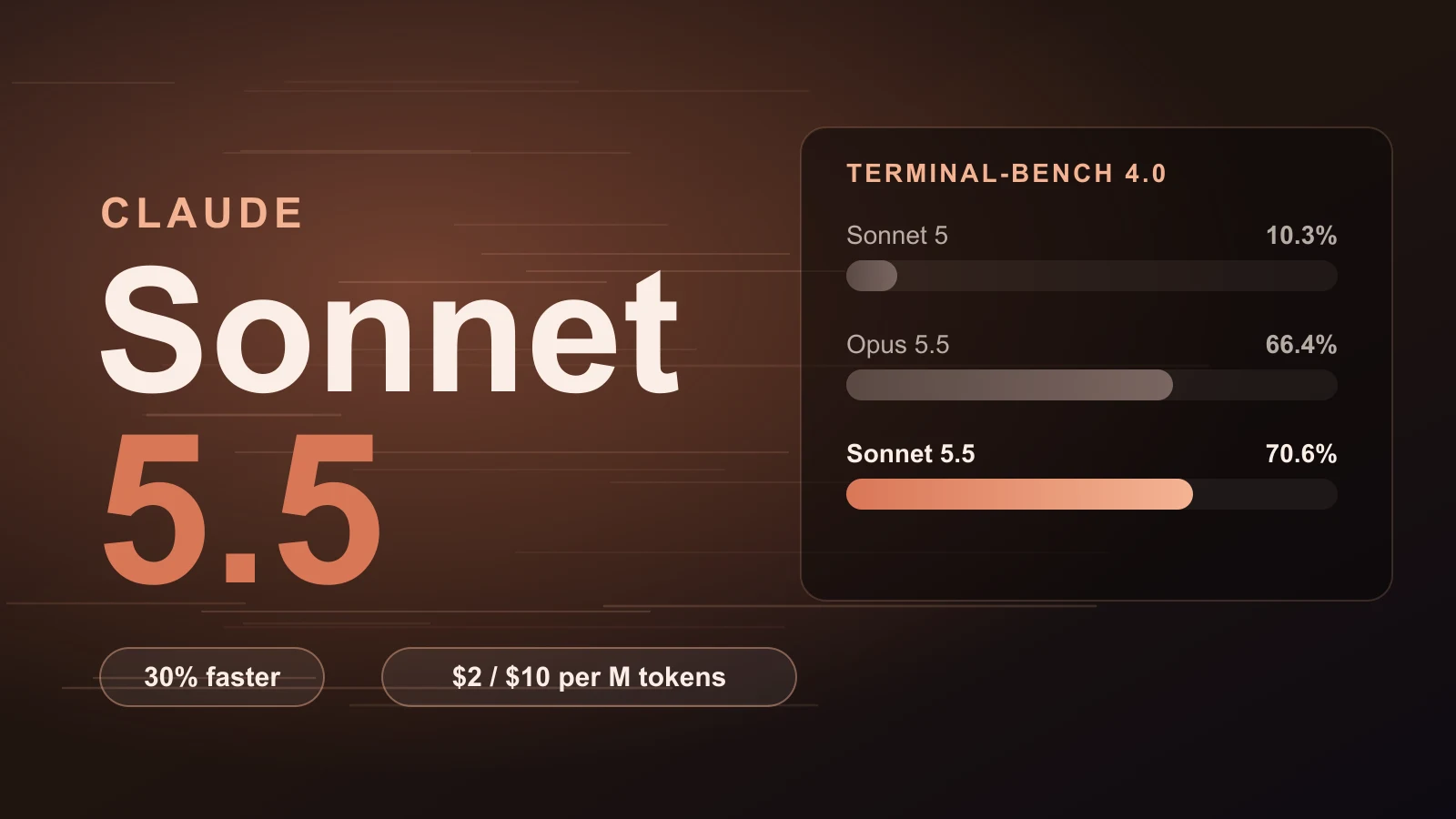
Anthropic released Claude Sonnet 5.5 today, the second model in the 5.5 family, a few days after Opus 5.5. It is pitched as the everyday work partner: over 30% faster than Sonnet 5 at generating output and up to 30% cheaper per task, because it gets the same work done with fewer tokens and fewer tool calls. The per-token price did not change: $2 per million input tokens and $10 per million output tokens.
The biggest jump is in agentic coding. On Terminal-Bench 4.0, Sonnet 5.5 scores 70.6%, against 10.3% for Sonnet 5 and 66.4% for Opus 5.5, which costs twice as much. It is available now on the Claude Platform, AWS, Google Cloud and Microsoft Azure as claude-sonnet-5-5, and Haiku 5.5 is coming "in the coming weeks".
The numbers that matter
Anthropic positions Sonnet 5.5 as strongest at well-scoped everyday tasks: fixing bugs and producing polished documents, slides and spreadsheets. The launch benchmarks show a model that comes close to Opus 5.5 on almost everything and beats it on one:
| Benchmark | Sonnet 5 | Sonnet 5.5 | Opus 5.5 |
|---|---|---|---|
| Terminal-Bench 4.0 | 10.3% | 70.6% | 66.4% |
| CursorBench 4.0 | 34.1% | 55.5% | 57.8% |
| FrontierCode 1.1 (Max) | 42.4% | 46.2% | 54.4% |
| OSWorld 2.1 (computer use) | 57.0% | 80.1% | 81.8% |
| GDPval-AA v2.1 (knowledge work) | 1449 | 1844 | 1846 |
| Humanity's Last Exam (with tools) | 54.9% | 64.5% | 67.7% |
It is also the first Sonnet to beat Pokémon Red working only from screenshots, a test of stamina on long tasks and of image understanding.
Cheaper per task, not per token
The list price is the same as Sonnet 5's, so the savings come from spending less. The customers quoted in the announcement give the scale: Balyasny Asset Management ran 2,441 finance tasks and saw the average drop from 497,000 to 121,000 tokens per answer; Box measured runs 2.4 times faster with 12% fewer tokens; Base44, across 118 real app builds, needed 3.6 iterations on average against 7.7 for Opus 5. For anyone running many agents in parallel, that is where Sonnet 5.5 beats Opus: nearly the same quality, half the price per token and fewer tokens per task.
The first Sonnet with Opus-grade guardrails
Two safety changes reach a Sonnet for the first time. Higher-risk cybersecurity requests now visibly fall back to Sonnet 5, the same safeguards that used to exist only on the flagship models; defenders can apply for wider access through the Cyber Verification Program. And the model launches with classifiers that block reasoning extraction: preserved thinking is tied to the account that produced it. According to The Next Web, it answers the August episode in which researchers decoded 315,320 thinking blocks from 6,708 public agent traces and recovered credentials.
In practice, if you run Sonnet in production, the switch is mostly the model ID. Check two things first: the migration notes ask you to move the reasoning setting from thinking_off to between_tools, and binding reasoning to the account affects anyone who switches accounts in the middle of a Claude Code session.
Sources and further reading
Share this news
Related Items
- NewsOpenAI launches Dots, agents that keep working after you log off, and GPT-6.1 Sol at a fifth of Astra's priceEach dot runs on GPT-6 Astra with its own cloud computer and connections to more than 4,000 apps, and asks before sensitive actions. GPT-6.1 Sol costs $2 and $10 per million tokens and matches Astra on DeepSWE. Both arrived a day after OpenAI cancelled GPT-6.1 Astra for acting beyond what users had authorized.
- NewsMeta releases Muse Spark Open, an 816B open-weight model built to run on two Mac StudiosThe mixture-of-experts model activates 42B of its 816B parameters per token, reads text, images, video and audio, and has a 1M-token context. Meta calls it the most capable US open-weight model, and its own table backs that up while still putting it behind GLM 5.3 and Kimi K3 on most agent and coding benchmarks.
- NewsBlack Forest Labs releases FLUX 3 Image, with 4K output and edits placed by coordinatesThe image model of the FLUX 3 family generates and edits through one endpoint, combines up to ten reference images and lets developers place or change elements with bounding boxes. It costs $0.048 per 1K image, half that until October 8, and open weights are promised within weeks.
Comments
Questions, corrections, or your own take are all welcome. Sign in with GitHub to join in.